
RV Tire Pressure Monitors
An RV tire fails differently from a car tire. It carries more weight, often sits for months between trips, and on a towable there is nobody sitting above it to feel anything go wrong. A TPMS is the instrument that closes that gap — it reports, in the minutes before a slow leak becomes a blowout.
What a TPMS actually does
Sensors at each wheel position transmit pressure and, on most systems, temperature to a display in the cab. When a reading crosses a threshold, it alarms.
That is the whole function, and it is worth being precise about the value: the system does not prevent a failure. What it buys is warning — time to slow down and pull over on a slow leak, or notice a temperature climbing on one wheel because a brake is dragging. Heat is often the earlier signal, which is why temperature reporting matters as much as pressure.
Sensor count is an axle-count decision
Across 60 listings the median kit ships four sensors and the 75th percentile six. That distribution describes vehicles rather than quality: four covers a two-axle trailer, six a motorhome with a tag axle or a trailer plus the tow vehicle’s rear wheels, and eight to ten a larger coach with a towed vehicle behind it.
Count your wheel positions first, including anything you tow. Then check the maximum the display supports, which is a hard limit and is rarely stated in the title.
The pressure ceiling is a compatibility check
Rated pressure ceilings in this category run from 99 psi at the 25th percentile to 188 at the 75th. That spread maps onto two kinds of tire: travel-trailer and light-truck tires running 50–80 psi, and heavy motorhome tires running considerably higher.
A sensor whose ceiling sits below your cold inflation pressure cannot report the number you need. Read your tire placard’s maximum cold pressure and buy above it with margin, because pressure rises as tires warm on a long run.
See the RV TPMS spec comparison — sensor count and pressure ceiling quartiles across 60 listings, both read from titles because Amazon publishes neither as a structured field.
Internal or external sensors
External
Screw onto the valve stem. Replaceable by the owner in minutes, batteries swappable, and they can be moved between vehicles. Exposed to weather and theft, and they add rotating mass at the stem.
Internal
Mounted inside the tire. Protected and invisible, with no valve-stem load. Replacing a battery means dismounting the tire, which turns a five-minute job into a shop visit.
Our corpus does not publish which type a product uses often enough to compare, so this is a check to run on the product’s own page.
The thing that catches people out
Signal has to travel from the rearmost wheel of a long rig to a display in the cab, through a metal structure. On larger coaches and long fifth wheels a repeater is frequently necessary, and whether one is included — or even available — is not something the specifications tell you. If your rig is long, treat this as a question to answer before buying rather than after.
A TPMS reports; it does not protect. We do not test this equipment, and nothing here is a safety assurance. Your tire placard is the authority on pressures, and a system that alarms as a tire fails has done its job even when the tire still fails.
Compare them
The finder below is already scoped to this class — 60 of the 450 products in the corpus. Widen or narrow it from there, or open the full RV monitoring finder to search everything at once. Every result is placed against the median for its own size band, where that band holds at least eight products with a stated figure.
60 products match
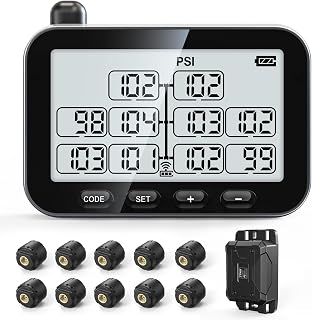
GUTA GT30 Trailer Tire Pressure Monitoring System, RV TPMS with 10 Sensors | Monitors Up to 46 Tires for 3 Trailers, Signal Booster, 6 Alert Modes, LCD Display, 0–188 PSI for RV, 5th Wheel, Motorhomes
Weight
0.70kg
Tire Pressure Monitors · 300 g – 1 kg · 26 products
Weight is +25% against the class median of 0.56.

Tymate TM8 RV Tire Pressure Monitoring System, TPMS Set of 4 Sensors | Max. 4 Tires Info Monitoring, Windshield Mounted, 6 Alarm Modes, 0-87 PSI, Solar/USB Charge, Color LCD, Ideal for RV/SUV/Cars
Weight
0.22kg
Tire Pressure Monitors · under 300 g · 20 products
Weight is -3% against the class median of 0.23.

GUTA GT60 RV Tire Pressure Monitoring System, 10 Sensors, 7" Color LCD | Solar & USB-C Charging, Monitor Up to 16 Tires, 0-188PSI for Trailers, MotorHomes,5th Wheels, 6 Alarm Modes, Signal Booster
Weight
1.08kg
Too few products in this class to publish a baseline.

TireMinder i10 RV TPMS with 6 Transmitters
Weight
0.87kg
Tire Pressure Monitors · 300 g – 1 kg · 26 products
Weight is +56% against the class median of 0.56.

Hieha Rv Tire Pressure Monitoring System, 7.84” Solar TPMS for Rv Travel Trailer Coach Truck Fifth Wheel Motorhome with 6 Sensors, Real-time Monitoring Pressure and Temperature(0~198PSI)
Weight
0.86kg
Tire Pressure Monitors · 300 g – 1 kg · 26 products
Weight is +54% against the class median of 0.56.
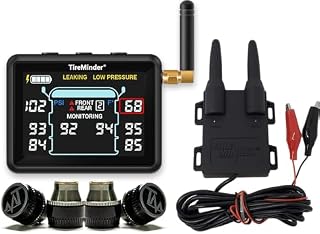
TireMinder i10 RV TPMS with 4 Transmitters, Black
Weight
0.82kg
Tire Pressure Monitors · 300 g – 1 kg · 26 products
Weight is +46% against the class median of 0.56.

Trailer Tire Pressure Monitoring System 10 Sensors,0-188PSI RV TPMS with 4.5" Large Solar Monitor 6 Alerts, Signal Booster for Truck/Camper/Motor Homes,Long Sensing Distance
Weight
0.72kg
Tire Pressure Monitors · 300 g – 1 kg · 26 products
Weight is +29% against the class median of 0.56.

GUTA GT30 Trailer Tire Pressure Monitoring System, RV TPMS with 6 Sensors | Monitors Up to 46 Tires for 3 Trailers, Signal Booster, 6 Alert Modes, LCD Display, 0–188 PSI for RV, 5th Wheel, Motorhomes
Weight
0.58kg
Tire Pressure Monitors · 300 g – 1 kg · 26 products
Weight is +3% against the class median of 0.56.

EEZTire-TPMS6ATC Real Time/24×7 Tire Pressure Monitoring System – Color Monitor + 6 at Sensors
Weight
0.54kg
Tire Pressure Monitors · 300 g – 1 kg · 26 products
Weight is -3% against the class median of 0.56.

Tymate TM2 RV Tire Pressure Monitoring System, TPMS 6 Sensors & Booster Kit | Max. 10 Tires Info Monitoring, 6 Alarm Modes, 0-144PSI, Extended Signal Distance, For RV/Fifth Wheel/Trailer/Camper/Motorhome
Weight
0.44kg
Tire Pressure Monitors · 300 g – 1 kg · 26 products
Weight is -22% against the class median of 0.56.

Tymate TM12 RV Tire Pressure Monitoring System, TPMS Set of 6 Sensors | Max. 12 Tires Info Monitoring, 6-Tire Display, 6 Alarm Modes, Solar/USB Charge, 50ft Range, 0-144PSI for RV/Trailer/Camper
Weight
0.35kg
Tire Pressure Monitors · 300 g – 1 kg · 26 products
Weight is -38% against the class median of 0.56.

Tymate TM5 RV Tire Pressure Monitoring System, TPMS Set of 4 Sensors | Max. 10 Tires Info Monitoring, Large Color LCD, 5 Alarm Modes, 0-144PSI, USB Charge, For RV/Fifth Wheel/Trailer/Truck/SUV/Car
Weight
0.33kg
Tire Pressure Monitors · 300 g – 1 kg · 26 products
Weight is -41% against the class median of 0.56.
How many sensors, and what that decides
The median kit here ships four sensors, which covers a car or a small trailer and not much else. A dual-axle caravan behind a dual-rear-wheel tow vehicle needs ten, and buying the four-sensor kit first and topping up later depends entirely on whether the manufacturer sells sensors separately and whether the monitor supports the count. Both are worth confirming before buying, because a system that cannot be extended is a system that has to be replaced.
The pressure ceiling is a compatibility check, not a feature
Most kits here state a maximum readable pressure, and the median sits comfortably above what a car runs and uncomfortably close to what some trailer tyres do. A sensor whose ceiling is below the tyre's cold pressure reads nothing useful, and the failure is silent — the display shows a figure and the figure is wrong. Check the tyre placard first and the sensor's ceiling second, because this is the specification that makes a kit simply not applicable rather than merely mediocre.
Internal against external sensors
External sensors screw onto the valve stem and can be fitted in minutes; internal ones sit inside the tyre and need it removed. External is the sensible default for almost everyone: fitting costs nothing, batteries are replaceable without a tyre shop, and the theft risk is mostly theoretical. Internal sensors win where the wheels are unusually exposed, where valve stems are short, or where the extra mass on the stem is a genuine concern at speed.
Batteries, and the maintenance nobody plans for
Every sensor is a battery, and a ten-sensor system is ten batteries that will need attention on their own schedule. Some use replaceable cells and some are sealed, which turns a maintenance job into a replacement purchase. It is worth knowing which before buying, because the difference shows up two years in rather than on the listing, and a monitoring system that has stopped monitoring is worse than none — it occupies the place on the dashboard where the warning would have been.
Common questions
How many sensors do I need?
One per wheel position you want monitored, including the tow vehicle or towed car. The category median of four covers a two-axle trailer and nothing beyond it.
Will a car TPMS work on my RV?
Usually not well. The pressure ranges are lower, the sensor counts are smaller, and the transmission distance on a long rig is beyond what a car system is designed for.
Is temperature monitoring worth having?
It is often the earlier warning. A dragging brake or a failing bearing shows as heat before it shows as pressure loss.
Do you recommend a specific system?
No. We publish the category’s distribution so you can place a candidate against it once you know your wheel count and your placarded pressures.