

RV Battery Monitors
Voltage is a poor proxy for state of charge, and the factory light that shows three bars is worse. A proper battery monitor counts what goes in and out rather than guessing from terminal voltage — which is a different measurement, not a more precise one.
Why voltage alone misleads
A battery’s resting voltage does correlate with charge, but only at rest. Under load it sags; under charge it rises; and for lithium chemistries the curve is so flat through the middle of the range that a tenth of a volt can span a large part of the usable capacity.
The alternative is a shunt: a precision resistor in the negative line through which all current flows. The monitor measures that current and integrates it over time, so it counts amp-hours in and out and reports a state of charge derived from what actually moved rather than from what the terminals happen to read.
Voltmeter-style
Reads terminal voltage, sometimes with a percentage estimate derived from it. Cheap, trivially installed, and inherits every limitation above.
Shunt-based
Counts current through a shunt in the negative line. Reports amp-hours consumed, time remaining and state of charge. Requires cutting into the battery negative, which is real electrical work.
This category does not support a comparison. Weight and battery voltage clear both our gates across 70 products, and neither is a buying signal — shunt amperage rating, voltage range and Bluetooth support are unpublished as structured attributes. The category is also just 68% on topic: the search returns battery chargers, a KIB panel system and, in one case, a pet temperature monitor. No comparison page is published here.
What to check on the product’s own page
- Shunt amperage rating. It must exceed the largest current your system will ever pass, which usually means an inverter’s peak draw rather than anything routine.
- Supported chemistry. Lithium, AGM and flooded batteries have different charge curves, and a monitor that cannot be told which you have will report state of charge badly.
- Programmable capacity. The monitor needs to know your bank’s amp-hours to compute a percentage at all.
- Whether it logs history — cycle count and depth of discharge tell you more about battery health over a season than any instantaneous reading.
Installing a shunt means working on the battery negative. That is a live electrical connection with real fault current available. Your rig’s documentation and a licensed installer are the authority, not a website that does not test equipment.
Compare them
The finder below is already scoped to this class — 56 of the 450 products in the corpus. Widen or narrow it from there, or open the full RV monitoring finder to search everything at once. Every result is placed against the median for its own size band, where that band holds at least eight products with a stated figure.
56 products match

ANCEL BA101 Car Battery Tester, 12V Digital Automotive Alternator Meter Diagnostic Tool,100-2000 CCA Load Capacity, Charging & Cranking Analyzer for Truck, Boat, RV, Marine Vehicle, and More
Weight
0.14kg
Battery Monitors · under 300 g · 25 products
Weight is +89% against the class median of 0.08.
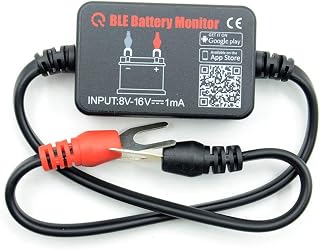
BM2 Bluetooth Battery Monitor 12V Car Battery Tester for Lead Acid, Auto Battery Load Tester with Cranking Charging Test, LowVolt Alarm for Car/RV/Motorcycle/Truck/Boat/Solar Power System
Weight
0.08kg
Battery Monitors · under 300 g · 25 products
Weight is +9% against the class median of 0.08.

Renogy 500A Battery Monitor, Tester with Shunt, Battery Meter Power System | High & Low Voltage Programmable Alarm, 10V-120V and up to 500A, 20ft Shielded Cable, Compatible with 12V Lithium Sealed, Gel
Weight
0.08kg
Battery Monitors · under 300 g · 25 products
Weight is 0% against the class median of 0.08.

ANCEL BM200-US Car Battery Tester 12V Automotive Battery Monitor Bluetooth | Auto Battery Load Tester with Cranking Charging Test Alarm Record Voltage History Voltmeter for Car/RV/Motorcycle/Truck/Boat
Weight
0.05kg
Battery Monitors · under 300 g · 25 products
Weight is -33% against the class median of 0.08.
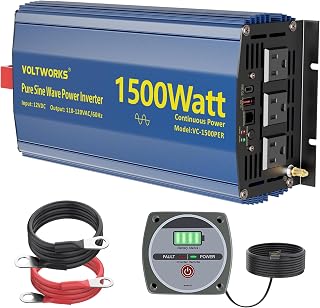
Power Inverter 1500W Pure Sine Wave Inverter 12V to 110V 120V AC with PD36W USB-C Builtin UL Fuse 15FT Remote with Battery Monitor Compatible with Lithium Battery Statlink for Car Off-Grid Solar RV
Weight
2.90kg
Too few products in this class to publish a baseline.

Battery Tender Plus 12V 1.25 AMP Car & Motorcycle Battery Charger and Maintainer, Float Charge for Automotive, and ATVs – Smarter Than a Trickle Charger
Weight
0.68kg
Too few products in this class to publish a baseline.
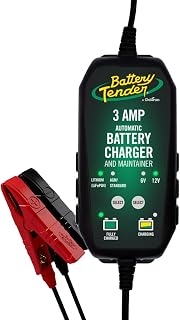
Battery Tender 3 AMP Battery Charger and Maintainer – Automotive Switchable 12V or 6V Smart Automatic for Cars SUVs and Trucks – Lead Acid, AGM, Gel, & Lithium Battery Charger – 022-0202-COS
Weight
0.64kg
Too few products in this class to publish a baseline.

Newentor CO2 Monitor, Indoor Air Quality Meters, Carbon Dioxide Detector | Large Display CO2 Tester with Voice, Temperature Humidity Sensor, Alarm Clock for Home, RV, Grow Tents, White
Weight
0.14kg
Battery Monitors · under 300 g · 25 products
Weight is +81% against the class median of 0.08.

DROK AC Multimeter, 50-300V 0-100A with Open Transformer 110V 220V Voltage Current Power Electric Energy Monitor, Ampmeter Voltmeter LCD Screen for Home-use
Weight
0.10kg
Battery Monitors · under 300 g · 25 products
Weight is +27% against the class median of 0.08.

Innova 3721 Battery and Charging System Monitor
Weight
0.09kg
Battery Monitors · under 300 g · 25 products
Weight is +21% against the class median of 0.08.

12V Plug in Car Battery and Charging System Tester, Test Car Power Condition & Alternator Charging(LCD Display Car Battery Monitor Voltmeter)
Weight
0.08kg
Battery Monitors · under 300 g · 25 products
Weight is +7% against the class median of 0.08.

12V 24V 36V 48V 60V 72V LED Battery Monitor Meter Battery Fuel Gauge Indicator ELMCONFIG BM210 Lead-Acid&Lithium ion Battery Tester for Golf CART Yamaha Club CAR EZGO Stacking Machine Motorcycle
Weight
0.04kg
Battery Monitors · under 300 g · 25 products
Weight is -52% against the class median of 0.08.
Shunt-based against voltage-only
A voltage reading is a poor proxy for state of charge, especially on lithium, where the voltage curve is nearly flat across most of the usable range — a pack at eighty per cent and one at thirty can read almost the same. A shunt measures current in and out and counts what has actually gone where, which is the only method that answers the question people actually ask. Voltage-only monitors are cheaper and are best understood as alarms rather than gauges.
Installing a shunt means breaking the negative
A shunt has to carry every amp leaving the battery, which means it goes in the main negative path with nothing bypassing it. Any circuit wired around the shunt is invisible to the monitor, and a single forgotten chassis ground is enough to make every reading optimistic in a way that never announces itself. This is the most common installation error in the class and the reason a monitor sometimes reports a battery that never quite empties.
Chemistry has to be told, not detected
A monitor calculates capacity remaining from a profile it is given, and the profile for lead-acid is not the profile for lithium. Fitting a monitor and leaving it on defaults produces confident numbers that are wrong, usually in the direction of overstating what is left. Setting the capacity, chemistry and charge efficiency is a five-minute job that decides whether every figure afterwards means anything.
What the weight figure here tells you
This is the lightest class on the site by a clear margin, which is a reminder of what is being bought: a shunt, a display and some wire. The cost sits in the accuracy of the measurement and the quality of the software reading it, neither of which appears in a specification table. Where two monitors differ in price and not in stated specification, the difference is usually the calibration and the app.
Bluetooth, and what happens when the app stops
Many monitors here report only to a phone, which is convenient until the manufacturer stops maintaining the app or the phone updates past it. A monitor with its own display keeps working regardless. Where the only interface is an app, the useful question is whether the device is still readable if the software disappears — and for a component expected to last as long as the vehicle, that is not a hypothetical.
Common questions
Is a shunt monitor worth it over a voltmeter?
If you rely on the house bank away from shore power, the difference is between knowing and guessing. If you are hooked up most of the time, a voltmeter tells you most of what you need.
Why is there no comparison page here?
Because only weight and a battery-voltage figure cleared our gates across 70 products, and neither is a reason to choose a battery monitor.
Will a monitor work with lithium?
Many do, and it is a configuration question rather than a given. Check that the specific model supports your chemistry and lets you set the bank capacity.
Do you recommend a specific monitor?
No. We publish what the category does and does not document.