

RV Surge Protector Spec Comparison
The measured baseline for RV surge protectors and EMS units across 46 listings — amperage and joule rating. This is the best-documented category on the site, and it is also the one where the first specification you read eliminates half the market before any comparison begins.
Amperage is a filter, not a comparison axis
Before anything else: a surge protector is built for either a 30 amp or a 50 amp shore-power service, and the two are different physical connectors carrying different supplies. A 30 A service is a single 120 V leg. A 50 A service is two 120 V legs giving 240 V across them, which is why it delivers roughly four times the power rather than 1.67 times.
Your rig has one or the other. Buying the wrong one is not a compromise on quality, it is a unit that does not fit.
| Amperage | Share of category | Service |
|---|---|---|
| 30 A | The 25th percentile and the median | Single 120 V leg |
| 50 A | The 75th percentile | Two 120 V legs, 240 V across |
Amperage is stated on 98% of listings — the highest coverage of any specification anywhere in this repo, which is what you would expect of a fact that determines whether the product is usable at all. It comes from product titles and bullets rather than a structured attribute.
The category baseline
46 listings, of which the following carried usable data.
| Specification | Products with data | Coverage | P25 | Median | P75 |
|---|---|---|---|---|---|
| Amperage (A) | 45 | 98% | 30 | 30 | 50 |
| Surge rating (joules) | 33 | 72% | 4,200 | 12,000 | 16,000 |
| Weight (kg) | 26 | 57% | 0.80 | 0.97 | 1.27 |
What the joule rating does and does not tell you
The joule figure is an energy-absorption rating: how much surge energy the unit’s protective components can take before they are used up. The spread in this category is wide — 825 joules at the bottom of the sample, 20,000 at the top, with a median of 12,000 and a P75 of 16,000 — and the distribution skews high because newer units compete on this number.
A joule rating is a consumable budget, not a permanent property. Metal-oxide varistors, the usual protective component, degrade each time they clamp a surge. A unit that has absorbed several events has less protection left than its printed rating, and nothing on the outside necessarily tells you so. This is why units with an indicator showing protection status are worth more than the difference in their joule numbers suggests, and why a very old surge protector of unknown history is not doing the job you think it is.
It is also worth being clear about what this rating does not cover. A joule figure describes surge absorption. It says nothing about the faults that damage RVs most often on shore power: open ground, reversed polarity, an open neutral, and sustained low or high voltage. Those are the province of an electrical management system rather than a plain surge protector, and the distinction is the most important one in this category.
| Type | Protects against | Does not protect against |
|---|---|---|
| Surge protector | Voltage spikes, and usually reports wiring faults at the pedestal | Sustained over- or under-voltage; it reports rather than disconnects |
| EMS | Spikes plus sustained voltage excursions, open neutral and miswired pedestals — by cutting power | Nothing in this list, but it costs more and is a larger unit |
Sustained low voltage is the failure that kills air conditioner compressors, and it is not a surge. A unit that only reports a fault leaves the decision to you; a unit that disconnects makes it while you are asleep.
How to place a unit against this
- Filter by amperage first. Match your rig’s service. Nothing else matters until this is right.
- Decide surge protector or EMS. This is a bigger decision than any number in the table, and it is about which failures you want handled automatically.
- Then read the joule rating, against the quartiles above. Below 4,200 is the bottom quarter of the category; above 16,000 is the top.
- Prefer a unit that shows its protection status, because the rating you bought is not the protection you still have.
This page cannot tell you your rig is protected. We publish what manufacturers state. We do not know your rig’s service, its wiring, or the condition of the pedestal you are plugging into, and no specification here should be read as a promise that a fault will be prevented. Where the question touches your electrical system, your rig’s documentation and a licensed installer are the authority.
The Products These Figures Come From
Of the 46 units in this category, 21 publish every figure in the baseline above. The 10 shown here are listed by price tier, then alphabetically — this is not a ranking, and a product appearing here means its listing is complete, nothing more. 3 listings are held back for a published figure far outside the category’s own range — a data defect rather than an unusual product.
| Product | Brand | Price Tier | Amperage (A) | Surge rating (J) | Weight (kg) | Key Details |
|---|---|---|---|---|---|---|
 CREATIVE DESIGN RV Surge Protector 30 Amp |
CREATIVE DESIGN | <$30 | 30 | 12,000 | 1.04 | Reports faults on a dual-color LED; sealed cap with dual gaskets; states UL1449 4th Edition |
 EPLCSE RV Surge Protector 30 Amp |
EPLCSE | <$30 | 30 | 10,000 | 0.87 | Circuit analyzer with LED indicators; flame-retardant body, waterproof cover; FCC and RoHS claimed |
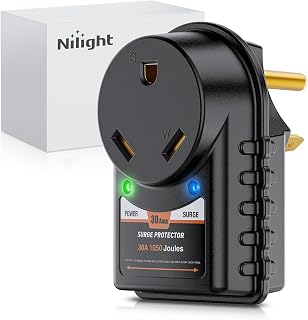 Nilight 30 Amp RV Surge Protector ETL Listed TT-30P TT-30R |
Nilight | <$30 | 30 | 1,050 | 0.17 | NEMA TT-30P/TT-30R rated 125 V and 3750 W; ETL listed; LED indicates whether the source is safe |
 POWGRN 30 Amp RV Surge Protector 26000J Overload Auto… |
POWGRN | <$30 | 30 | 26,000 | 0.88 | Auto shutoff on fault with manual reset; screen reads voltage, current and power; anti-theft ring |
 30000J 50Amp RV Surge Protector 50 Amp Flag Design… |
Not stated | $30-75 | 50 | 30,000 | 1.38 | NEMA 14-50 rated 125 V and 6250 W; MOV, GDT and TVS layers; 3-year warranty stated |
 AMEHO RV Surge Protector 30 Amp |
AMEHO | $30-75 | 30 | 16,000 | 0.97 | Auto shutoff and reconnection; IP67 cover; screen reads voltage, amperage, wattage and kWh |
 EyGde RV Surge Protector 15 Amp to 30 Amp Waterproof |
EyGde | $30-75 | 15 | 6,600 | 0.93 | A 15 A male to 30 A female adapter as well as a protector; analyzer LED; IP67 cover |
 Southwire Surge Guard 44290 Portable Surge Protector… |
Southwire | $75-200 | 50 | 4,200 | 0.45 | Identifies faulty park power; thicker receptacle brass to cut heat; anti-theft lock ring on the cord |
 Southwire Surge Guard™ 30 Amp Portable RV Surge Protector… |
Southwire | $75-200 | 30 | 2,100 | 0.68 | Identifies faulty park power; thicker receptacle brass; Easy-T-Pull handle with integrated receptacle |
 Toldear RV Surge Protector 50 Amp Smart RV Circuit Analyzer… |
Toldear | $75-200 | 50 | 12,000 | 1.50 | Detects wiring faults; IP68 cover; display reads voltage, current, power and kilowatt-hours |
Key Details summarize what each listing states about itself, in our words rather than the seller’s. Every claim is checked against the listing text it was taken from.
Notes on the Products at the Edges
Most of the products above sit inside the interquartile range on every figure, which is what the baseline already describes. These are the ones it does not: each is outside P25 or P75 on at least one published figure. The position is computed from the category statistics; the explanation is what the listing itself states.
Nilight 30 Amp RV Surge Protector ETL Listed TT-30P TT-30R — Nilight, <$30
Weight of 0.17 kg sits below the category P25 of 0.80 kg. The lightest unit here is adapter-shaped rather than a boxed analyzer: its listing states 1050 Joules and a 22500A maximum spike, well under the heavier units above.
30000J 50Amp RV Surge Protector 50 Amp Flag Design… — Not stated, $30-75
Surge rating of 30,000 J sits above the category P75 of 16,000 J. A 50 amp unit whose stated ratings read 50A / 125V / 6250W, with the joule figure attributed to MOV, GDT and TVS layers.
POWGRN 30 Amp RV Surge Protector 26000J Overload Auto… — POWGRN, <$30
Surge rating of 26,000 J sits above the category P75 of 16,000 J. Its listing contrasts the 26,000J rating against a typical 9,500 to 15,000J, and pairs it with automatic disconnection that stays off until reset by hand.
Specifications are the manufacturer’s published values as scraped for this corpus, not our own measurements — the same source, and the same limits, as the baseline above. Prices move daily, so we show the tier rather than an amount. Links to Amazon are affiliate links.
What this category does not publish
Response time in nanoseconds, clamping voltage, whether the unit is weather-rated for permanent outdoor use, and whether it is hardwired or portable are all absent from structured data and inconsistent in the bullets. Those, together with the EMS distinction, are what actually separate these products.
Nothing above is a recommendation, a ranking or a test result. We do not own an RV and we do not install this equipment. The method, including both gates, is on comparison methodology.
Common questions
Can I use a 50 A protector on a 30 A rig?
Not directly — the connectors differ, and adapters change what the unit is monitoring. Buy for the service your rig actually has rather than adapting around a mismatch.
Is a higher joule rating always better?
More absorption capacity is better all else being equal, but the rating is a consumable budget rather than a permanent guarantee, and it does not address the sustained-voltage faults that cause the most expensive damage. An EMS with a lower joule number can be the better protection.
Why is the median joule rating so much higher than the 25th percentile?
Because the category contains both older entry-level units around 800–4,200 joules and newer models competing at 12,000 and above, up to 20,000. The distribution is genuinely wide rather than noisy.
Do you rank these units?
No. This page is a distribution so you can place a specific unit against its category, after you have filtered by amperage and decided whether you want an EMS.